

The Cure Crew Toolkit
Fundraising & Events
Whether you’re hosting a solo event or rallying your community, there are so many creative ways to raise funds in support of scleroderma research. Every fundraiser, big or small, makes a difference.
Fitness & Wellness
Walk, Run, or Ride for Research
Organize a 5K, bike ride, or walking challenge. Invite friends to sponsor each mile or donate in honor of someone you're walking for.
Yoga for a Cause
Partner with a local yoga studio or instructor to host a donation-based class, virtual or in person.
Dance-a-thon or Zumba Class
Get moving and raise funds with a fun, high-energy event open to all ages.
Community & Social
Trivia Night
Host a trivia game at a local bar, coffee shop, or online. Charge an entry fee and offer prizes for the winning team.
Cook-Off or Bake Sale
Organize a chili cook-off, BBQ, or bake sale, and ask participants to donate or "vote" for winners with dollars.
Garage Sale
Donate proceeds from sales and invite friends to contribute gently used items.
Craft or Art Fair
Showcase local talent and donate a portion of sales from handmade goods, photography, or art.
Online Campaigns
- Birthday or Milestone Fundraiser — Celebrate your birthday, anniversary, or other milestone by asking for donations instead of gifts through a Facebook fundraiser.
- Streaming or Gaming for a Cure — Go live on Twitch, YouTube, or Facebook and raise money while playing games, performing music, or hosting tutorials.
- Matching Gift Challenge — Offer to match donations up to a certain amount to inspire others to give. Great for employers or local business sponsors.
Workplace & School
- Lunch & Learn Awareness Event — Host a short educational session about scleroderma research and invite colleagues to donate.
- School Spirit Week Fundraiser — Organize themed days, donation jars by homeroom, or a read-a-thon to engage students and staff.
Fundraising Templates
Here are easy-to-use templates for your personal fundraiser, emails, thank-you notes, and social media posts. Just personalize the language to fit your story, and you’ll be ready to inspire your community to support the SRF in the search for a cure to scleroderma.
Title: Join Me in Supporting Innovative Research for Scleroderma
Main Message:
I’m fundraising for the Scleroderma Research Foundation because I believe in the power of research to change lives. Scleroderma is a rare and complex autoimmune disease that has no known cure—but together, we can help accelerate progress.
Every dollar raised supports patient-focused research, clinical trials, and the development of
better treatments. I’m doing this for [insert your personal connection to scleroderma].
Please consider making a donation today. Your support brings us one step closer to better therapies—and ultimately, a cure. Thank you so much.
Subject Line Options:
- Help Me Fund Research for Scleroderma
- Will You Join Me in Supporting Scleroderma Research?
Body:
Hi [Name],
I wanted to share something important with you. I’m currently fundraising for the Scleroderma Research Foundation (SRF), an organization that’s leading the charge in finding better treatments—and a cure—for scleroderma.
Scleroderma is a chronic autoimmune disease that affects the skin and internal organs. It’s complex, underdiagnosed, and often misunderstood. The SRF funds groundbreaking research that is helping to create real change for people living with this disease.
This cause means a lot to me because [insert personal reason].
If you’re able, I’d be so grateful if you’d consider making a donation to my fundraiser. Every gift—no matter the size—makes a difference. Here’s the link: [Insert link to your online fundraiser]
Thanks so much for your support.
With appreciation,
[Your Name]
Short Text or Direct Message Thank You
Thank you so much for your donation. Your support means the world to me—and to everyone affected by scleroderma. Together, we’re making a difference.
Email Thank You
Subject: Thank You for Supporting Scleroderma Research
Hi [Name],
Thank you so much for your generous donation to my fundraiser for the Scleroderma Research
Foundation. Your support helps fuel life-changing research and offers hope to patients and
families facing this challenging disease.
You’re helping move science forward—and bringing us closer to a cure for scleroderma.
With heartfelt thanks,
[Your Name]
Social Media Shoutout Thank You
A huge thank you to [@Name] for supporting my fundraiser for the Scleroderma Research
Foundation. Your generosity helps advance critical research and gives hope to people living
with this disease. #SRFCure #SclerodermaResearch #SayScleroderma
Cure Crew Posts
Show your pride in being part of the Cure Crew and invite others to join you.
The Scleroderma Research Foundation (SRF) Cure Crew is a grassroots group of volunteers helping spread awareness and fund research for a scleroderma cure. I’m proud to be part of it, and there are so many ways to participate—big or small. Want to join me? Comment below and I’ll give you more info.
I am proud to be a Cure Crew member with the Scleroderma Research Foundation! This volunteer network is united in a shared belief in the power of research to help people with scleroderma live longer, fuller lives and, ultimately, find a cure. Being part of the Cure Crew means I get to raise awareness, support cutting-edge research, and be part of something bigger than myself. Learn more on the SRF website: https://srfcure.org/support-us/cure-crew
I joined the SRF Cure Crew to make an impact on scleroderma research—because progress starts with people like you and me. The Cure Crew is a community of volunteers helping to raise awareness, fund research, and support those living with scleroderma. Every action helps move us closer to new treatments and a cure. Learn how you can join me: https://srfcure.org/support-us/cure-crew
Quick Facts about Scleroderma Posts
Here are key facts about common complications that you can use to spread awareness about what scleroderma is and does.
Most people living with scleroderma have mild to severe gastrointestinal problems. This can appear in many forms and involve different levels of risk, from simple indigestion to esophageal blockage.
The GI tract in our body is involved in consuming and processing the food we eat and eliminating waste. In scleroderma, fibrosis (scarring) makes the walls of the gut thicker and the muscles don’t work as effectively. This affects the way food is moved through your body and digested and causes digestive problems.
Some GI symptoms scleroderma patients may have include stomach pain, difficulty swallowing, and acid reflux, nausea, heartburn or indigestion, and changes in appetite. Fortunately, most symptoms can be managed with help from your healthcare team.
The GI system is complex. Treating GI symptoms is important but diagnosis and treatment will differ according to the location of the symptom or problem.
Learn more about scleroderma, and what’s being done to end this disease, through the Scleroderma Research Foundation (@srfcure).

How does scleroderma affect your joints?
When scleroderma affects the body, it can impact everything from tendons to joints, leading to changes in mobility.
The increased production of collagen associated with scleroderma can cause vascular dysfunction. This can contribute to stiffness, warmth, tenderness, and pain in the joints and muscles.
Development of fibrotic tissue can affect movement. Additionally, scarring and thickening of the skin can cause painful contractures of the fingers, wrists, or other joints, causing them to become “stuck” in a flexed position.
Aspirin or other non-steroidal, anti-inflammatory prescriptions can help with muscle pain and stiffness. Simple hand and face exercises may ease specific symptoms and gentle cardiovascular exercise that focuses on your entire body (walking, swimming, yoga) can also help. Be sure to talk to your doctor about your treatment plan before using any new medications.
Learn more about scleroderma, and what’s being done to end this disease, through the Scleroderma Research Foundation (@srfcure).
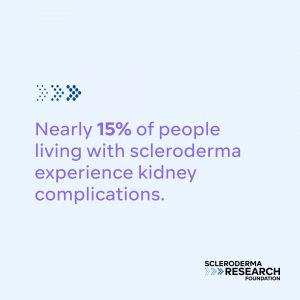
Scleroderma can affect many different parts of the body, including the kidneys. In systemic scleroderma, the kidneys can be damaged due to a sudden and severe increase in blood pressure. This is called scleroderma renal crisis (SRC).
SRC is very serious. Sudden onset of high blood pressure (hypertension) of more than 150/85mmHg is the key symptom of renal crisis. It causes an almost immediate decrease in kidney function. Some symptoms to watch for include headache, visual disturbances, seizures, fever, changes in blood or urine chemistry, and pulmonary edema (fluid in the lungs).
One class of antihypertensive medications known as angiotensin converting enzyme inhibitors (ACE inhibitors) are effective, although many patients require more than one drug. If the blood pressure can be promptly and completely controlled, kidney injury can be prevented and over time can reverse.
Learn more about scleroderma, and what’s being done to end this disease, through the Scleroderma Research Foundation (@srfcure).
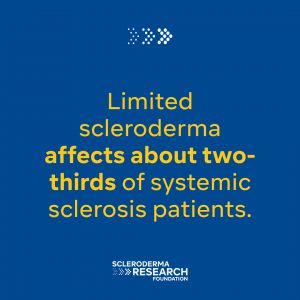
Let’s talk about the most common type of scleroderma: limited scleroderma.
Limited scleroderma affects about two-thirds of systemic sclerosis patients. It’s sometimes called CREST Syndrome, because of these commonly associated physical characteristics:
- Calcinosis—hard, painful calcium deposits in the skin.
- Raynaud’s Phenomenon—when the feet and hands turn white, then blue, then red in response to cold or stress.
- Esophageal problems—trouble swallowing or acid reflux.
- Sclerodactyly—tightening of the skin on the fingers and toes.
- Telangiectasias—small red spots due to dilated blood vessels on the face, lips, forearms, or fingers.
Limited (CREST) scleroderma usually progresses more slowly than diffuse scleroderma. Chronic pain, loss of mobility, and disfigurement are possible. Treating limited scleroderma symptoms is very important. The disease can still be life-threatening. It is critical to monitor for organ damage. Serious complications can occur related to the esophagus, other parts of the gastrointestinal tract, and the lungs.
Learn more about scleroderma, and what’s being done to end this disease, through the Scleroderma Research Foundation (@srfcure).
Skin ulcers affect about 50% of people with limited or diffuse scleroderma. Let’s break down the basics of what they are and management approaches.
For people with scleroderma, skin ulcers most often appear at the tips of fingers (digital ulcers). Skin ulcers may also extend under the fingernails, or to the joints at pressure points like elbows when the skin is stretched too tight. Scleroderma skin ulcers may also occur on the legs or other parts of the body following minor trauma such as a bruise. These sores may be very painful and can make it difficult to use your hands or other parts of your body.
Some ways to prevent skin ulcers include avoiding stress and cold, keeping as warm as possible, using Band-Aids, and wearing layers of clothing. Basic wound care and over-the-counter (OTC) medications may help with healing and pain management. Medications for skin ulcers in scleroderma may also be recommended.
Learn more about scleroderma, and what’s being done to end this disease, through the Scleroderma Research Foundation (@srfcure).

Glossary Terms Posts
Help others understand the language of scleroderma with easy-to-share definitions.
Everyone should know what scleroderma is and how it affects people. One way scleroderma can impact those living with it is through a complication called sclerodactyly.
Sclerodactyly is the thickening and tightening of the skin on the fingers or toes. Not everyone with scleroderma will develop this complication. For those who do, this can affect mobility significantly. It yields a characteristic claw-like appearance and may render digits immobile.
Learn more about scleroderma, and what’s being done to end this disease, through the Scleroderma Research Foundation (@srfcure).

Scleroderma is a complex disease that can progress in very variable ways. Along with the signature skin fibrosis (hardening) that characterizes scleroderma, there are other scleroderma complications related to the skin that may occur. Let’s talk about one of these complications—telangiectasias.
Telangiectasias are abnormal blood vessels that usually appear as red dots on the skin or may look like varicose veins, with a spider-web form. Patients with scleroderma may develop telangiectasias on the arms, hands, fingers, the face, chest, and in the mouth. Other locations might be over joints, and around the toenails or fingernails. They will fade or turn white when the skin is pressed and are not painful or dangerous.
The condition occurs with both limited and diffuse scleroderma. Telangiectasias in scleroderma become more numerous over time in both types of the disease; however, evidence suggests they occur more frequently in patients with limited scleroderma (CREST).
Learn more about scleroderma, and what’s being done to end this disease, through the Scleroderma Research Foundation (@srfcure).