

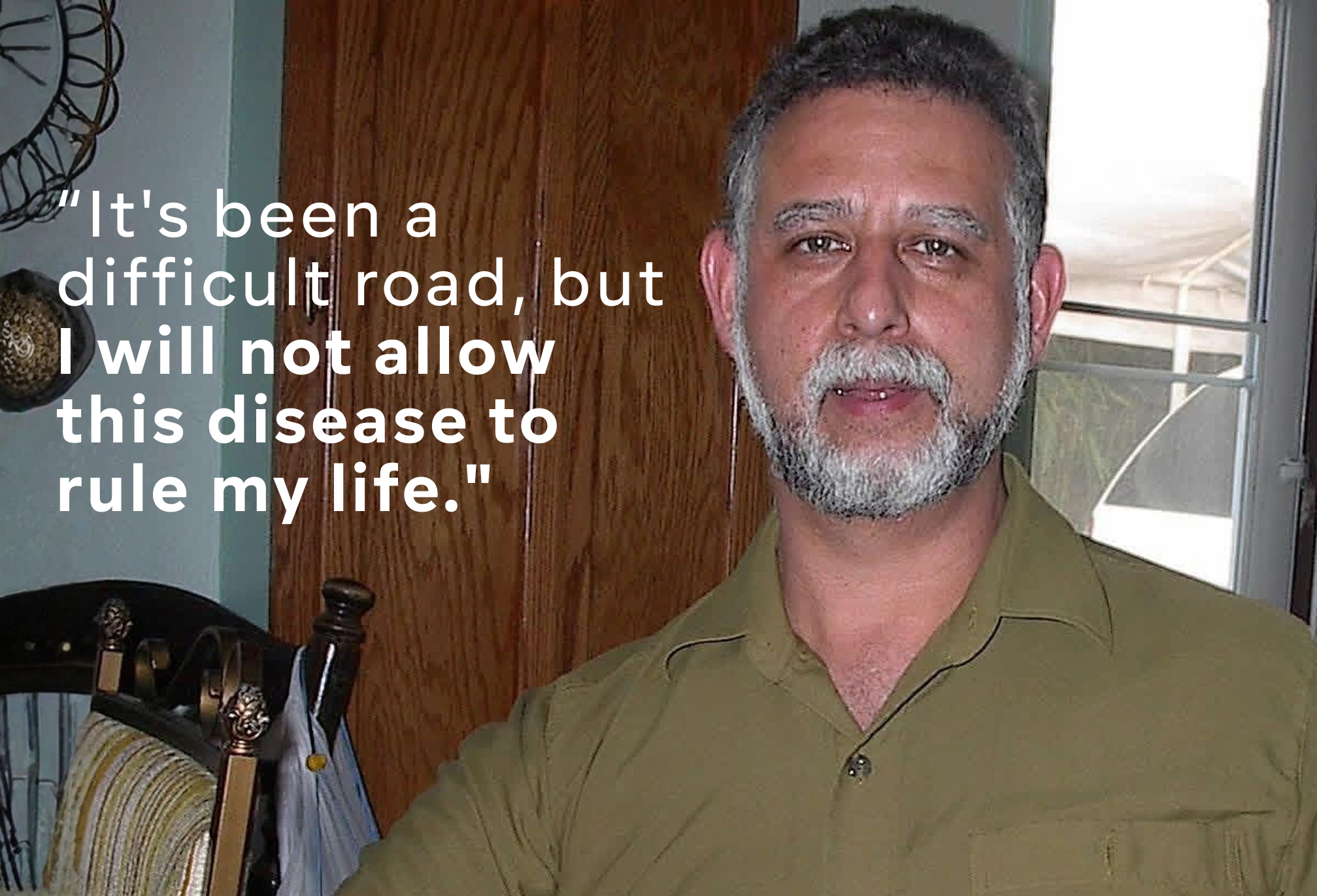
“As far as scleroderma and PAH go, I just ‘go with the flow,'” says Lorenzo T. (dx 2012), who lives with diffuse scleroderma, interstitial lung disease (ILD), and pulmonary arterial hypertension (PAH). “I will not allow this disease to rule my life.”
November is Pulmonary Hypertension (PH) Awareness Month. PH is a form of pulmonary hypertension that develops when the arteries in the lungs become narrowed, thickened, and rigid, so the heart must work harder to push blood through them. For people living with scleroderma, PAH (which is a type of PH) is one of the most common and serious complications, and regular screening can help care teams catch the condition earlier and improve health outcomes.
“Four symptoms began in January of 2012, while at work and at various times and locations,” Lorenzo recalls. “I did not concern myself about them too much at the time.” First came an unexplained pain in his left shin, then swelling in the fingers of both hands and on the back of his left hand.
Finally, he experienced Raynaud’s phenomenon. “All my fingers on both hands turned ghost white. After those symptoms showed up, I began to become alarmed,” Lorenzo says. His wife looked up the symptoms and recognized the signs of Raynaud’s phenomenon.
After visits with his primary care doctor and two rheumatologists, a specialist diagnosed him with diffuse scleroderma in August 2012. “The news hit hard, but I had no prior understanding of the disease,” Lorenzo says.
By December 2012, he was on work disability, and skin tightening and joint pain kept him in bed for most of the next year. “My wife helped me to the bathroom, got me dressed, and brought me food. Her help was invaluable,” he says. “I also exercised my legs as best I could, and now I can walk and drive.”
Lung complications followed, with an ILD diagnosis in 2016 and PAH later on. Lorenzo now uses oxygen around the clock and practices deep belly breathing a few times a day. “I get tired quickly, even with oxygen,” Lorenzo describes. “But I think it’s better to work with my disease than give in to it.”
Scleroderma has also changed what Lorenzo’s hands can do. “I eventually accepted that I could no longer play piano, but still feel pride that I was able to play at some time in my life,” he says. “Though I have a lot of limitations, I am proud that I was able to do many things and have a new life with different abilities. I have never given up, even though I do grieve my losses from time to time.”
Through it all, he holds on to hope. “Optimism has taken over the anger and frustration,” Lorenzo says. “It’s been a difficult road, but I’ll keep on keeping on. I continue to live for my wife, my dog, myself, friends, and other family members who remember me, love me, and accept me.”
Thank you, Lorenzo, for openly sharing your story and helping spread awareness. This November, learn the signs of this serious complication, talk with your care team about screening, and take action for PH Awareness Month.