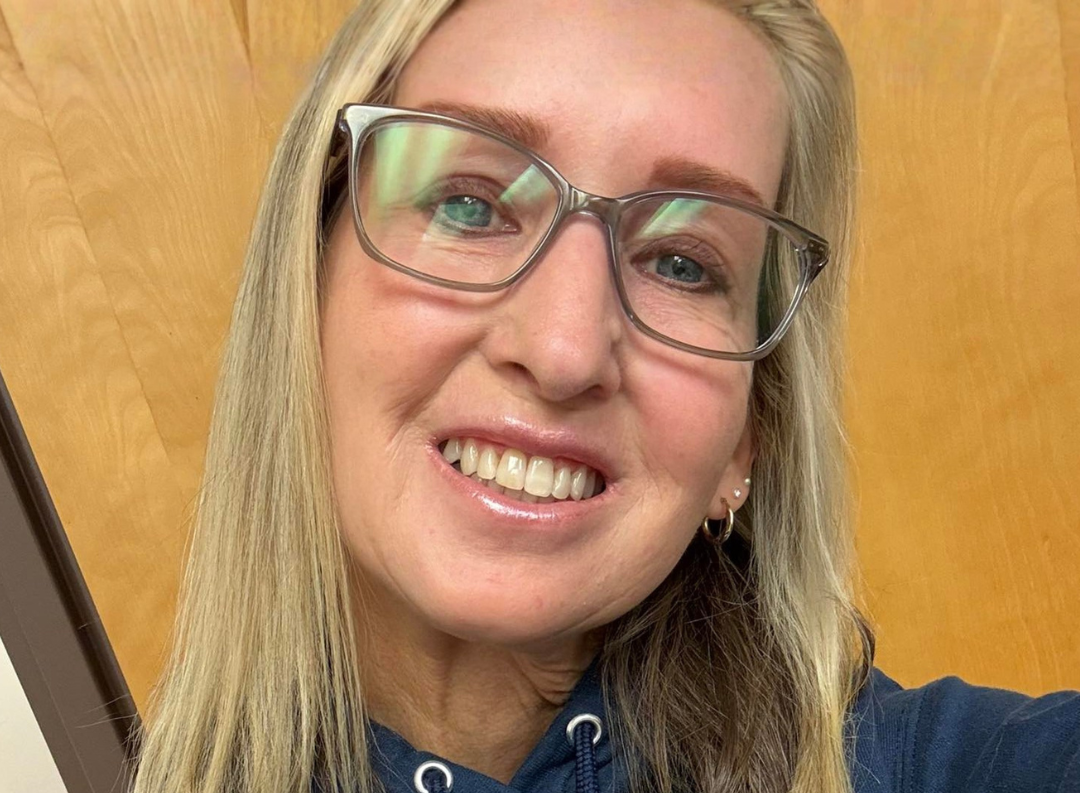
“Raynaud’s has never really sidelined me. I just roll with whatever my body serves up as best I can,” says Julia P. (dx 2011). “Despite all that I have been through, I know that I was lucky because my disease was diagnosed earlier.” February is Raynaud’s Awareness Month, and Julia’s experience highlights how recognizing the signs of Raynaud’s can lead to earlier diagnosis, earlier specialist care, and ultimately better outcomes for people living with scleroderma.
For Julia, Raynaud’s phenomenon was the first sign that something wasn’t right, but it took nearly a year before she would receive a scleroderma diagnosis. “I told my doctor about my hands turning white and blue sometimes, and he said it was Raynaud’s, and that it was common for runners to get,” she recalls. “But when I told my dermatologist about white spots on my arm when I would lift weights, she took a biopsy, and it came back positive for scleroderma.”
Julia’s biopsy was followed by a positive ANA test, and she was referred to a rheumatologist in Philadelphia. As doctors worked to understand the full scope of her condition, her symptoms intensified. “It amazed me how quickly the progression started,” Julia says. “I was tired a lot and I kept dropping weight, even as I took different medications.”
By 2012, still searching for more specialized care, she was referred to Dr. Ami Shah at John Hopkins Scleroderma Center in Baltimore, an SRF-funded investigator and rheumatologist. “It took about a year to get to the right specialist,” Julia explains. “Although it took some time, the right treatment for me was found.”
Raynaud’s remains a daily reality for her. “Early on, I would wear fingerless gloves and warm hunting style socks to keep me warm,” she says. “I get flare ups often, and I have learned to keep my core warm, not just my extremities, so I am almost always layering my clothing all seasons of the year.”
Throughout her scleroderma journey, Julia has pushed herself to keep going. “It was tough, but I had to be present for my daughter and take care of her. It was sad for me to lose all my strength and not be able to carry my little girl up for bedtime,” she remembers.
“I make a point to push my body, and I do it for me, but also to show other scleroderma patients that it can be done,” Julia says. “I have participated in several marathons, Spartan obstacle course races, and most recently, have become a bodybuilder! We all have different abilities, but even with scleroderma, we have abilities.”
“I want to make a difference for the community,” she says. And Julia definitely does—she participates in research, has advocated in Washington DC for research funding, attends support groups and conferences, and has even appeared in a short film about scleroderma.
After everything she’s endured, she believes that real change is possible through research. “This disease is an invisible beast that doesn’t always get diagnosed until too late. Because scleroderma is a rare disease, there no popular population to bring it to the forefront,” Julia says. “I think finding the cause will help to find the cure.”
“Scleroderma has changed the way I look and face obstacles in life. I have scleroderma but I refuse to let it have me,” she says.
Thank you, Julia, for sharing your story and helping raise awareness about Raynaud’s and scleroderma. This month, take action for a chance to win in our special Raynaud’s Awareness giveaway.