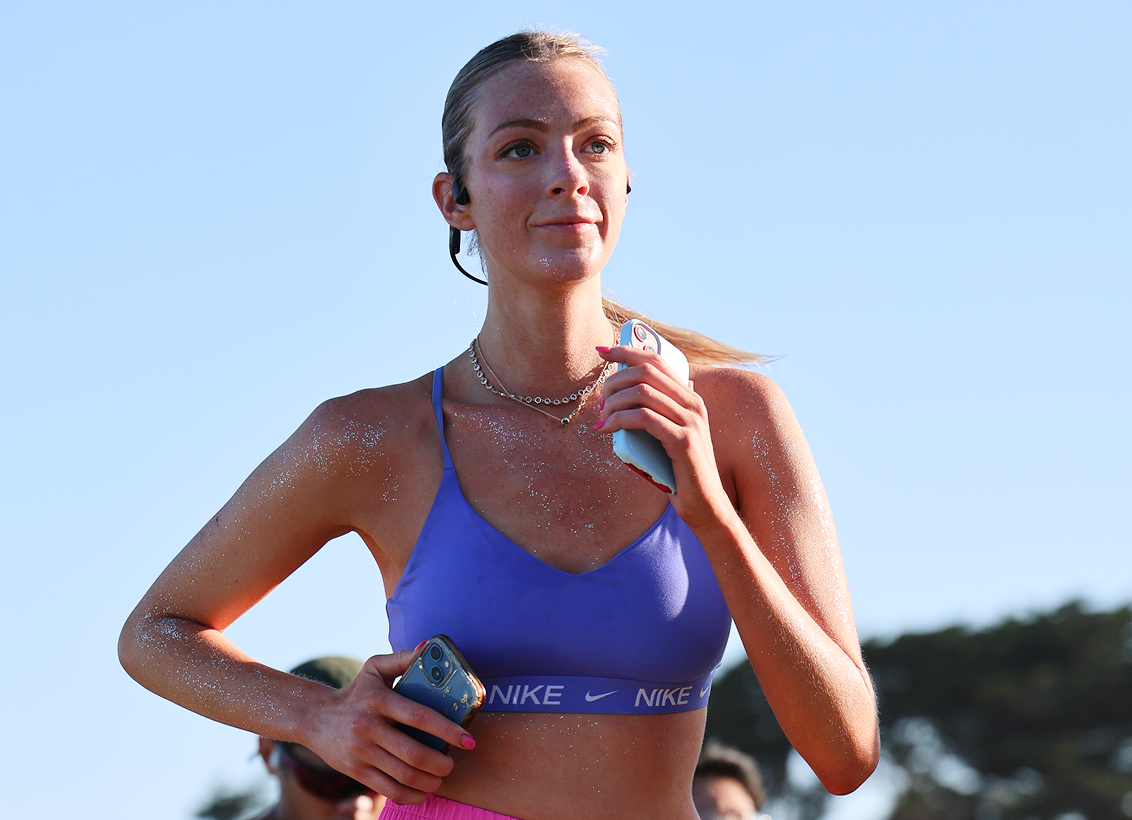
Last weekend, Lindsay M. (dx 2021) took on the 2026 San Francisco Marathon in support of scleroderma awareness and research. We sat down with her to talk about what inspired her to run, her personal journey with scleroderma—from early symptoms to diagnosis —and what she hopes the future holds for scleroderma research. Here’s what she shared, in her own words.
What inspired your choice to run the SF Marathon?
I am an adamant believer that any sort of progress in medicine requires a blend of science and awareness. While medical research is, ultimately, an engine for progress, visibility is the catalyst that fuels it; exposure certainly matters, even within our own personal circles! So, in that sense, I concluded that running in the San Francisco Marathon would be an excellent medium through which I could do my part in bringing a vital condition like scleroderma into the light it so urgently deserves. Scleroderma, a disease most struggle even to pronounce, should not be a diagnosis shrouded in obscurity!
What was training like?
At the onset of my training, I read a quote that I believe perfectly encapsulates all that I’ve experienced across the past seven months of my training: “A marathon is a public display of private will.”
While marathon training is a formidable task for anyone, doing so while living with scleroderma introduces a unique layer of complexity. It demands unwavering diligence, sacrifice, and the resolve to keep on trucking, especially in the wake of difficult circumstances. Throughout the course of my training, I logged my miles in the aftermath of three-foot snowstorms, during inopportune moments in my international travels, and through the turbulence of less-than-stellar life shifts.
Yet, due to my zeal for the cause for which I was running, sticking to the task was something that I never even remotely questioned. I am so honored to have done my part in raising funds for the Scleroderma Research Foundation, and look forward to contributing in any way that I can in the future!
Can you share your journey from first symptoms to diagnosis?
My fervent advocacy for scleroderma research and awareness stems from my personal experience with the difficulty of receiving a diagnosis. It’s my belief that if more people (including medical professionals) possessed a broader knowledge of what scleroderma entails, I would have been properly diagnosed years earlier instead of having my concerns repeatedly misattributed to something else.
In retrospect, the warning signs were present long before my official diagnosis, which occurred in 2021 at age 26. My symptoms began subtly with Raynaud’s phenomenon, as my fingers and toes would habitually turn white and blue in certain environments. My extreme fatigue and severe cold-sensitivity were often dismissed by others as mere personality quirks, as I was often written off as the friend who routinely retreated to bed much too early and who couldn’t tolerate temperatures below sixty-five degrees.
During my first year of teaching, however, my condition escalated. I began developing telangiectasia on my body as well as calcinosis in my fingers (which one physician remarkably and quite inaccurately attributed to using too much hand sanitizer). Shortly thereafter, my most frightening symptom surfaced: esophageal dysmotility. There were periods of time when I was physically unable to swallow food or liquid, which was very jarring to experience. Yet, when I sought help, medical professionals repeatedly brushed my concerns aside, concluding that I was “just anxious,” a response that, ironically, only heightened my distress. Only so many doctors can prescribe “yoga and meditation” as antidotes before you’ve had enough.
Disheartened but undeterred, I knew that the only answer was to continue to advocate for myself. My persistence paid off when an astute physician finally ordered an ANA (antinuclear antibody) test. The positive result of this ANA test set off a process that ultimately led to my scleroderma diagnosis! Today, I am profoundly grateful to be under the care of an extraordinary Scleroderma Center in New York City, where I finally feel heard and supported. But, unfortunately, expert care cannot entirely shield me from the reality of this disease.
In the winter of 2023, while immersed in the daily stress of a high-pressure teaching environment, I found myself routinely working twelve to fifteen-hour days. The unrelenting stress triggered a devastating flare-up in esophageal dysmotility that left me unable to swallow most foods or liquids for nearly a month. It was a terrifying ordeal, but it served as a profound wake-up call, prompting me to permanently reorder my priorities and protect my physical and mental well-being.
This is precisely why research and awareness matter so deeply. No one should have to endure years of confusion in order to receive a name for what is happening to their body. By expanding our understanding of scleroderma, we can ensure earlier diagnoses, better treatments, and a clearer path forward for every patient who comes after me.
How has scleroderma most changed your life?
The theme at the heart of Walt Whitman’s poem, “O Me! O Life!” immediately comes to mind. In it, the speaker contemplates life’s meaning amidst what he perceives to be an assembly-line of struggle and doubt. Interestingly, my scleroderma diagnosis forced me to stop and absorb the poem’s ultimate answer: “That the powerful play goes on, and you may contribute a verse.”
My diagnosis, albeit world-altering, revealed that the true beauty of existence is simply being alive to experience the journey, and realizing that we hold the power to decide what our contribution will be, even in the moments of despair.
Scleroderma undeniably altered the terrain of my life, but in doing so, it sparked a profound awakening in how I choose to inhabit it. Prior to my diagnosis, I navigated the world with a strict, Capricornian sort of rigidity. I often found myself entangled in a cycle of relentless effort and output, quantifying my worth by my productivity, and seldom being fully present with others.
But a life-changing diagnosis confronts the patient with a choice: it forces one to pause and re-examine where genuine value lies. I knew that if I was going to fight this disease with everything I had while protecting my physical and mental well-being, I needed to fundamentally shift the lens through which I viewed the world.
Today, although I’m certainly not perfect, I’ve done my best to renovate my internal landscape. I have learned to trade productivity for peace, which has served me well! I live significantly more lightly, forgive others with an ease I didn’t know I possessed, and actively invite silliness into my life in any way that I can. I listen more deeply and value the company of others, yet I feel equally at home in my own company. I prioritize bucket-list experiences over to-do lists, a shift that has carried me across the globe this past year from England, Ireland, and Scotland to Canada, Greece, and Indonesia.
Living with scleroderma yields undeniable challenges, but it has also granted me a clarity that I might never have found otherwise. It taught me to realign my priorities and live with a spirit of curiosity, presence, and profound gratitude for this life and for everything I still have the power to do within it. And that, in part, is what brought me to running this marathon!
What do you hope that funding research into scleroderma will accomplish?
My hope (and ardent belief) is that funding research will, piece by piece, create definitive answers, effective treatments, and, ultimately, a cure for scleroderma. I’ve always been incredibly inspired by the mission of Sharon Monsky, the founder of the SRF. Despite understanding that finding a cure for this treacherous disease would be a lengthy trek that might extend beyond her time on Earth, Sharon believed that medical research is the single best way to create a world without scleroderma, and that fundraising is an integral part of enabling breakthroughs in research to come to fruition. Every cent sincerely makes an impact, and I am so honored to have done my part in raising funds for the Scleroderma Research Foundation!
We are so grateful to Lindsay for her dedication, her honesty, and her tireless efforts to uplift the scleroderma community.
Inspired by her journey? You can fundraise for the SRF too. Learn more below.